
Quick Answer
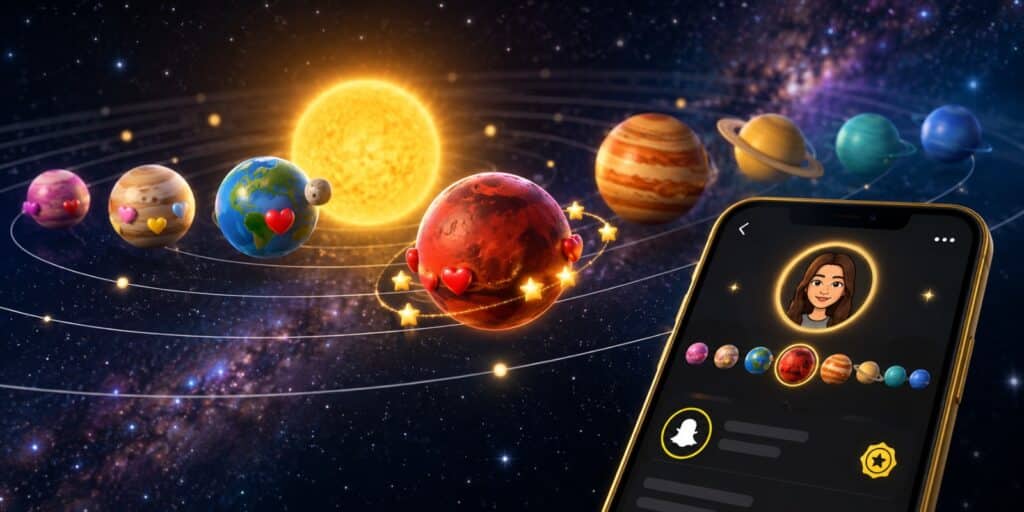
The red planet on Snapchat is Mars, and it marks your fourth closest friend inside the Friend Solar System, a Snapchat+ feature. Mars sits fourth in line after Mercury, Venus, and Earth, based on how often you snap and chat with that person. It appears as a red planet with hearts and stars around it.
Key Takeaways
- The red planet on Snapchat is Mars, ranked fourth out of eight best friends.
- Mars belongs to the Friend Solar System, a feature exclusive to Snapchat+.
- Only the profile owner needs Snapchat+, friends can still view the badge.
- Snap changed this feature to opt-in in 2024 after concerns about teen anxiety.
- Ranking depends on snap and chat frequency, not a public numeric score.
I noticed the red planet badge on a friend’s profile a few months back and had no idea what it meant until I dug into how Snapchat’s Friend Solar System actually works. Once you understand the order, it stops feeling random and starts making sense. A lot of guides online explain the full planet list but skip the part that matters most, how Snapchat handles this feature today after real changes it made in 2024.
The confusion is understandable. Snapchat rarely explains new features in detail inside the app itself, so most people only find a small planet icon with no context attached to it. That gap is exactly where a lot of guesswork and outdated information tends to spread.
The red planet on Snapchat is Mars, and it represents your fourth closest friend in someone’s Friend Solar System. This feature only appears for Snapchat+ subscribers and ranks up to eight friends as planets based on snap and chat activity. Mars sits between Earth and Jupiter in that ranking.
What Is the Red Planet on Snapchat
Mars is the red planet on Snapchat, and it shows up as part of the Friend Solar System feature. According to Snapchat’s own support page, this feature places a Snapchat+ subscriber at the center as the Sun, with up to eight friends orbiting as planets. Mars takes the fourth position, right after Mercury, Venus, and Earth.
Visually, Mars appears as a red planet with small hearts and stars orbiting it. If Mars shows up when you tap someone’s Best Friends badge, that means you are their fourth most active snap and chat contact. It is a solid ranking, not the top spot, but still well inside their closest circle.
The name choice makes sense once you think about it. Mars is genuinely red in real astronomy because iron oxide covers much of its surface, and Snapchat borrowed that same red color for the badge. Anyone familiar with the real solar system order can predict the Snapchat order without needing to memorize anything new.
One detail that trips people up is that Mars on Snapchat has nothing to do with Snap Score, Snap Map, or Bitmoji customization. It exists purely inside the Friend Solar System feature tied to Snapchat+. Confusing it with other ranking systems on the app is a common source of misunderstanding.
Where Mars Sits in the Snapchat Planet Order
The Friend Solar System follows the same order as the real solar system, starting closest to the Sun and moving outward. Each planet stands for a specific rank among a person’s top eight friends. The table below lays out the full order along with what each planet looks like.
| Rank | Planet | Visual Appearance |
| 1 | Mercury | Pink planet with red hearts |
| 2 | Venus | Cream or light brown planet with pink, yellow, and blue hearts |
| 3 | Earth | Blue and green planet with a moon and red hearts |
| 4 | Mars | Red planet with hearts and stars |
| 5 | Jupiter | Orange and red planet with stripes |
| 6 | Saturn | Orange planet with a ring |
| 7 | Uranus | Green planet with stars, no hearts |
| 8 | Neptune | Blue planet, farthest from the Sun |
Mars sitting fourth means the person still ranks you above four other friends. It is a meaningful position even though it is not the top three.
Notice that the visual design follows real astronomy fairly closely. Saturn keeps its ring, Earth keeps its moon, and Mars keeps its red color, which makes the whole system easy to remember after seeing it once. This attention to detail is part of why the feature caught on quickly among younger users when it first launched.
It helps to think of the order as a sliding scale rather than strict categories. The gap in activity between Mercury and Venus might be small, while the gap between Venus and Earth could be larger. Snapchat does not display these differences numerically, so the planet itself is the only signal available.
How Snapchat Decides Who Gets the Red Planet
Snapchat has not published an exact formula for how it ranks friends into planets. Based on Snapchat’s own explanation of Best Friends, the ranking reflects who you snap and chat with the most, tracked and updated on a regular basis. Mars specifically goes to the fourth most active contact in that ranking.
Consistency appears to matter more than short bursts of activity. A few days of heavy messaging with someone new is unlikely to push them straight to Mars if your usual top four already snap you daily. The list also updates over time, so a friend on Mars today could shift to Jupiter or up to Earth next month depending on how often you two interact.
Group chats and story views likely play a smaller role than direct snaps and one on one chats, though Snapchat has not confirmed exact weighting for any of these actions. Treating the feature as a rough activity tracker rather than a precise scoreboard sets more realistic expectations. Small daily interactions tend to matter more than one big conversation.
People sometimes ask whether unsending a snap or deleting a chat affects the ranking afterward. There is no public evidence that it does, since the ranking appears to track that an interaction happened rather than whether the content stays visible. This is another area where Snapchat keeps its internal logic private.
How to Check If You Are Someone’s Red Planet on Snapchat
Checking your position in a friend’s Friend Solar System takes only a few steps. You do not need your own Snapchat+ subscription to see where you rank on someone else’s list.
- Open the friend’s profile inside Snapchat.
- Look for a gold ring badge labeled Best Friends or Friends.
- Tap the badge to open their Friend Solar System.
- Find your Bitmoji and note which planet you are placed on.
- Remember that this shows your rank in their list, not theirs in yours.
If no badge appears at all, either that friend has not subscribed to Snapchat+, or you are not currently in their top eight.
There is also a third possibility worth checking before assuming either of those. Since the feature became opt-in back in 2024, a Snapchat+ subscriber may simply have the Friend Solar System turned off in their own settings. In that case, no badge shows for anyone, regardless of who ranks where.
If you want to see your own Friend Solar System instead of someone else’s, you will need an active Snapchat+ subscription yourself. Once subscribed, go to your Snapchat+ settings, find the Friend Solar System option, and toggle it on. Your own planet rankings will then appear the same way they do on any other subscriber’s profile.
Is Mars a Good or Bad Sign on Snapchat
Landing on Mars is a solid sign, not a disappointing one. Fourth place out of eight still means you are firmly inside someone’s closest circle of contacts. A common misconception treats anything below Mercury or Venus as a weak connection, which is not accurate.
Being someone’s Mars simply reflects current activity levels between two people, not the overall value of the friendship. Real life relationships involve far more than message frequency inside one app. Treating the red planet, or any planet below it, as a verdict on how much someone cares can create unnecessary stress over something that shifts regularly.
Context matters too. A friend who lives nearby and sees you daily in person may naturally snap less often than someone who lives far away and relies on the app to stay in touch. Mars for the first friend and Mercury for the second does not mean the second friendship runs deeper, it just reflects how each relationship happens to use the app.
Reading too much into a single planet position, especially a lower one, has been part of the real criticism this feature has faced since it launched. Keeping that context in mind helps avoid the exact kind of stress that led Snapchat to change how the feature works in the first place.
Why Snapchat Changed How the Solar System Feature Works
This is the part most guides on this topic leave out entirely. In 2024, Snapchat adjusted the Friend Solar System after the Wall Street Journal reported that the feature was fueling anxiety among teen users. Some young users reportedly avoided certain friends or felt hurt after seeing a lower ranking than expected.
In response, Snapchat turned the Friend Solar System off by default for new subscribers instead of removing it completely. According to Snapchat’s own support documentation, the feature is off by default for first time subscribers and must be turned on manually through Snapchat+ settings. Existing users who already had it enabled were not forced to change their setting.
This change means fewer people now see planet rankings automatically compared to when the feature first launched. Anyone curious about their own Friend Solar System, including where Mars falls, needs to actively enable it rather than assuming it is already visible.
Reports at the time described real situations where teens felt hurt after discovering a lower ranking than expected with a close friend or a crush. Some accounts described tension between friends after one person noticed they had dropped from Mercury to a farther planet. Snapchat’s decision to keep the feature available while making it opt-in was framed as a middle ground between removing it entirely and leaving it unchanged.
This history is worth knowing before enabling the feature for yourself. Going in with the expectation that rankings shift naturally, and that a lower planet does not carry deep meaning, tends to prevent the same frustration that prompted the original policy change.
Do You Need to Pay to See the Red Planet on Snapchat
Seeing someone else’s red planet badge costs nothing, since only the profile owner needs a paid plan. Snapchat+ is the subscription that unlocks the Friend Solar System, along with several other extra features. It launched in 2022 at $3.99 per month, and that base monthly price has stayed the same since.
An annual plan is also available at a discount compared to paying month to month, which suits anyone planning to keep the subscription long term. A higher Platinum tier exists too, mainly focused on reducing ads rather than adding new friend ranking tools. Neither tier changes how Mars or any other planet is calculated, since the ranking logic stays the same across all Snapchat+ plans.
If your goal is only to check where you rank on a friend’s list, you do not need to spend anything at all. A subscription only becomes necessary if you want to view your own Friend Solar System and see where your friends land around you.
Common Misconceptions About the Red Planet on Snapchat
A few myths keep circulating about how this feature works. Clearing them up avoids confusion the next time a friend’s planet badge shows up.
- Mars does not mean you are barely friends, it means you rank fourth out of eight.
- Seeing someone’s planet does not require your own Snapchat+ subscription.
- The planet order has nothing to do with Snap Score, which measures total app activity.
- Planet positions are private to the account owner, other friends cannot see your full list.
- A missing badge usually means the feature is turned off, not that you were removed as a friend.
Most of these misunderstandings come from comparing Snapchat’s planet system to older, simpler friend lists that just showed numbers. A visual ranking system naturally invites more speculation than a plain list would, which is part of why myths spread so easily around this particular feature.
FAQs
What does the red planet mean on Snapchat?
The red planet is Mars, and it marks the fourth closest friend inside someone’s Friend Solar System. It sits right after Earth and before Jupiter in the ranking order. This feature only appears for Snapchat+ subscribers.
Do I need Snapchat+ to see the red planet on someone’s profile?
No, only the profile owner needs a Snapchat+ subscription for the Friend Solar System to exist. Anyone can tap the Best Friends or Friends badge on a subscriber’s profile to view their own rank. You will not see the badge if the profile owner is not subscribed.
Why did my friend’s Snapchat planets disappear in 2026?
Snapchat made the Friend Solar System an opt-in feature back in 2024, and that setting still applies. If a friend never turned it back on after subscribing, no planet badge will show on their profile. They can re-enable it from the Snapchat+ settings menu at any time.
Is Mars a bad ranking compared to Mercury on Snapchat?
Mars is not a bad ranking, it simply means fourth place out of eight possible spots. Mercury reflects the single most active contact, while Mars still represents a strong, regular connection. Rankings shift over time based on snap and chat frequency.
How often do Snapchat planet rankings update?
Snapchat has not published an exact update schedule for the Friend Solar System. Based on how the Best Friends list behaves, rankings appear to adjust on a rolling basis tied to recent activity. A friend on Mars can move up or down as interaction patterns change.
Can I hide my own Friend Solar System from friends?
Yes, Snapchat+ subscribers can turn off the Friend Solar System from their Snapchat+ settings at any time. Once disabled, no one can view your planet badge or Best Friends ranking. This setting is separate from your own view of your best friends.
For more background on the actual planet, the Wikipedia entry on Mars covers its real astronomical details. Snapchat’s own support article on the Friend Solar System confirms exactly how the feature and its default settings work.
Understanding the red planet on Snapchat comes down to one simple fact, it is Mars, and it means you are someone’s fourth closest friend right now. That ranking can change as often as your conversations do, so do not read too much into a single snapshot. For the most current details on Snapchat+ features generally, Snap’s own Snapchat Support center is the most reliable place to check.
You may also read: The Real Cost of a Free AI Video Generator: A Practical Checklist


Pingback: Why Is Recycle Bin Showing Wrong File Names in Windows 11 - Tech World Garage