
Quick Answer: Digital publishing formats have pulled readers away from print at a slow, steady pace rather than replacing it. Ebooks and audiobooks keep growing, but print still holds the largest single share of readers today, and news readership is moving toward video far faster than book readership is moving toward digital formats.
Key Takeaways
- 75 percent of US adults read a book in the past year, per Pew Research
- Print reading dropped from 72 percent in 2011 to 64 percent in late 2025
- Ebook reading grew from 17 percent to 31 percent over the same period
- Audiobook use has more than doubled since 2011
- Younger readers lean far more heavily on ebooks and audiobooks than older readers
- News readership is shifting toward video and social platforms faster than books are shifting formats
- Publishers expect search traffic to keep falling as AI answer tools grow
We track how people consume digital content across formats, and the impact of digital publishing formats on readership in the latest data tells a more balanced story than most headlines suggest. Digital publishing formats have changed a lot, but readers have not abandoned print the way many predicted a decade ago.
Every year brings a new prediction that print is finished, yet the actual survey data keeps telling a calmer story. Format choice has diversified, not replaced itself, and that distinction matters for anyone building or publishing content today.
The Impact of Digital Publishing Formats on Readership, in Brief
In short, the impact of digital publishing formats on readership has been to grow it rather than replace it, with print still leading, ebooks and audiobooks climbing steadily, and news readers shifting hardest toward video and social platforms.
How Has Reading Changed Since Digital Formats Took Over
Reading has not moved in one direction. People still read books at almost the same overall rate as a decade ago, they have just spread that reading across more formats.
According to Pew Research Center, 75 percent of US adults read all or part of a book in the past 12 months, based on an October 2025 survey of more than 8,000 adults. That figure has stayed fairly stable since Pew first asked the question in 2011.
What changed is the format readers reach for. Print use fell from 72 percent in 2011 to 64 percent in late 2025, while ebook use rose from 17 percent to 31 percent over the same period.
This gradual shift matters more than a single headline number. It shows readers adding digital formats on top of print habits rather than dropping print altogether, which changes how publishers should think about format strategy.
Do Younger and Older Readers Use Different Formats
Age plays a bigger role in format choice than almost any other factor Pew tracks. Younger adults have consistently leaned more heavily on ebooks and audiobooks than older adults across every survey wave since digital formats became mainstream.
This pattern holds steady today. Readers under 50 are considerably more likely to use audiobooks and ebooks regularly, while readers over 65 remain the group most attached to print.
For publishers and content sites, this means format strategy cannot be one size fits all. Content aimed at younger audiences benefits from mobile friendly, audio ready formats, while content for older, print loyal readers may still perform better as a traditional layout.
How Do Print, eBooks and Audiobooks Compare
Format choice depends heavily on convenience and reading habit, not just personal taste. The table below shows how the three main book formats have moved over roughly the same period.
| Format | Readers in 2011 | Readers in late 2025 |
| Print books | 72 percent | 64 percent |
| Ebooks | 17 percent | 31 percent |
| Audiobooks | Roughly half of 2025 levels | More than doubled since 2011 |
Print remains the only format used by a majority of readers, which is worth noting given how often digital formats get described as dominant. Growth in ebooks and audiobooks has also slowed since 2021, not accelerated, suggesting the market is settling into a steadier pattern rather than racing toward one dominant format.
Most digital readers are not digital only readers either. The large majority of people who read ebooks or listen to audiobooks also read at least one print book in the same year, which points to format blending rather than format replacement.
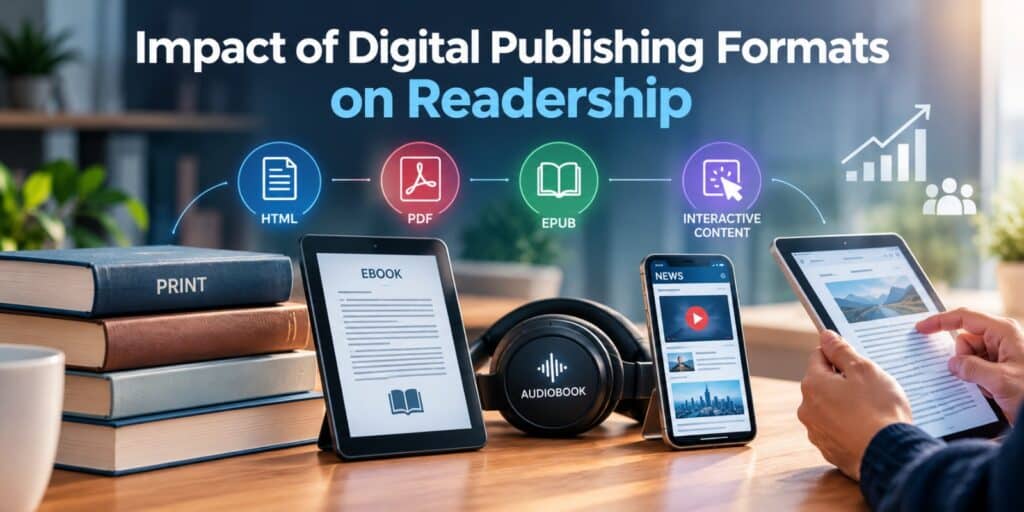
Digital Publishing Formats Explained: HTML, PDF, EPUB and Interactive Content
Not all digital reading happens in the same file type, and the format matters more than most readers realize. HTML pages, PDFs, EPUB files, and interactive content each affect load speed, readability, and how content ranks in search.
PDFs preserve layout but read poorly on small phone screens, since the page does not reflow to fit the device. EPUB files reflow text automatically, which makes them far better suited to ebook readers and mobile devices, though they lose fixed page design.
HTML remains the strongest format for search visibility and accessibility, since it can be indexed directly and adapted with screen readers. This is a large part of why more publishers are converting PDF heavy archives into responsive HTML pages rather than distributing static files.
Interactive content, including embedded audio, expandable sections, and clickable references, is becoming more common in digital magazines and long form articles. It adds engagement but also adds production time, so most publishers reserve it for flagship content rather than everyday posts.
We cover this comparison in full detail, including which format fits which type of publisher and reader, in our separate guide on digital publishing formats.
How Mobile Reading Is Changing Digital Publishing in 2026
Phones have become the default reading device for a large share of digital readers, and that shift is changing how publishers design content. Short paragraphs, larger fonts, and faster loading pages now matter more than traditional print layout ever did.
Mobile reading also changes reading behavior itself. Sessions tend to be shorter and more frequent on phones compared with tablets or dedicated ereaders, which pushes publishers toward content that can be read in small chunks rather than long uninterrupted sittings.
This shift affects book publishers and news publishers differently, since news content is read in much shorter bursts than books. A news article optimized for a two minute phone read follows very different formatting rules than a novel meant for an hour long evening session.
We break down the mobile reading shift and what it means for content formatting in a dedicated article on mobile reading trends.
How Is News Readership Different From Book Readership
News readership is moving faster and further than book readership. According to the Reuters Institute Digital News Report 2026, based on almost 100,000 interviews across 48 markets, social media and video networks are now used more often each week than television news or publishers’ own websites.
The same report found trust in news dropped in 29 of 48 markets surveyed, the lowest level recorded since tracking began. Among 18 to 24 year olds, more than half said social media, video, or AI tools are their main news source, and 44 percent of 25 to 34 year olds said the same.
This is a sharper shift than book readership has seen. Readers are not abandoning books for other formats at the same speed they are abandoning traditional news sites for video and social platforms, which suggests book publishing has more format stability than news publishing right now.
Platforms like YouTube, TikTok, and Instagram have seen steady growth as news sources in recent years, while older platforms such as X and Facebook Messenger have shown little growth as news sources over the past decade.
Why Genre and Content Type Affect Format Choice
Format preference is not uniform across content types either. Fast paced fiction and genre reading tend to move to audio and ebook formats more readily than dense nonfiction, which many readers still prefer in print for note taking and reference.
PressReader’s 2026 Year of Intentional Media report found readers are increasingly choosing lifestyle and hobby content, including food, health, puzzles, travel, and wellness, over hard news. For many publishers, these everyday formats now hold reader attention longer than breaking news does.
This shift toward intentional, routine based reading suggests format choice is becoming tied to purpose. Readers pick audio for commuting, ebooks for travel, and print for slower, focused reading at home.
What Are Publishers Doing Differently Today
Publishers are responding to falling search traffic and shifting attention with a few clear moves.
- Investing more in video content, with 79 percent of publishers surveyed by Reuters Institute increasing video production
- Preparing for a drop in search referral traffic as AI answer tools reduce clicks to original articles
- Leaning into original reporting and analysis that AI tools cannot easily replicate
- Publishing shorter, calmer content aimed at specific reader routines rather than chasing clicks
- Converting PDF heavy archives into responsive HTML for better mobile performance and search visibility
PressReader’s report found political content readership dropped 12 percent in 2025, while lifestyle and hobby content gained ground. That points to a real shift in what readers choose to spend time on, not just how they access it.
Confidence within the industry reflects these pressures. Fewer than four in ten editors, CEOs, and digital executives surveyed by Reuters Institute said they felt confident about the near term prospects for journalism, citing search traffic loss and growing competition from AI powered platforms.
What This Means for Readers and Publishers Going Forward
The overall picture right now is one of gradual format diversification rather than sudden disruption. Print remains central to book reading, digital formats keep gaining ground slowly, and news consumption is moving toward video and platforms faster than either. Seen together, the impact of digital publishing formats on readership looks more like steady evolution than the overnight shift many predicted.
Publishers that treat this as one trend risk misreading their audience. Book publishers and news publishers are facing different pressures, and the format strategy that works for one rarely transfers cleanly to the other.
For everyday readers, the practical takeaway is simpler. Format is becoming a matter of context rather than loyalty, with print for focus, ebooks for portability, audio for multitasking, and video for quick news updates.
For more coverage of how digital tools and formats are changing everyday tech habits, visit TechWorldGarage.
FAQs
What are the publisher trends for 2026?
Publishers are investing more in video, preparing for lower search traffic due to AI answer tools, and focusing on original reporting that stands out from AI generated content.
What are the current trends in digital publishing?
Ebook and audiobook use keep growing slowly, print remains the most used book format, and news readership is shifting toward social media and video platforms.
What are the key digital trends for 2026?
The biggest 2026 trends are platformization of news, rising video consumption, generative AI reshaping content workflows, and calmer, more intentional reading habits among audiences.
What are book publishers looking for in 2026?
Publishers are prioritizing original, distinctive writing that audiences trust over AI generated content, along with formats that work well on mobile devices.
For more detail on how digital news habits are shifting worldwide, the Reuters Institute has published its full Digital News Report 2026 findings based on nearly 100,000 interviews across 48 countries.
You can also read PressReader’s original 2026 Year of Intentional Media report for a closer look at how reader attention is shifting away from constant scrolling.