The overhead crane is one of the last heavy machines most people still picture as purely mechanical: a set of motors, a hook, and a human pressing buttons on a pendant. That picture is going out of date. Cranes are following the same arc as robotics and autonomous vehicles, moving from direct human control toward intelligent motion, and the shift is happening in the control system rather than the steel. The bridge and the hoist look much as they always have. What has changed is the layer of sensing, computation, and software that now sits between the operator and the motors.
The result is a machine that increasingly manages its own motion. It can damp the swing of a suspended load without an operator’s practiced touch, drive itself to a target position, keep its loads away from people and equipment, and in some settings run with no operator at all. This is a control-technology story, and it is worth understanding how the pieces fit together.
The Starting Point: A Human Doing All the Sensing
For most of the crane’s history, the control scheme was direct. An operator on a pendant or radio commanded the motors, and every bit of sensing and correction happened in the operator’s head and hands. The operator judged how fast to accelerate so the load would not lurch, feathered the controls to settle a swinging load before setting it down, watched for obstacles, and eased off before a hard stop. A skilled crane operator was, in effect, the feedback loop.
That approach works, but it has real limits. Under production pressure an operator has to manage bridge travel, trolley travel, hoisting, braking, positioning, and site safety at the same time, and human reaction time introduces overcorrection and residual swing. When the load is heavy, the hook is high, or the drop zone is tight, manual control gets harder precisely when precision matters most. Smart motion control exists to take the parts of that job that are really a control problem and hand them to a system built to solve it.
Anti-Sway: The Foundational Layer of Intelligence
The first and most important layer of smart crane behavior is anti-sway control, and it is a genuinely elegant piece of engineering. Any suspended load is a pendulum, and every time the crane accelerates, travels, and stops, that pendulum swings. The swing delays placement, threatens nearby equipment and people, and forces the operator to wait out the oscillation before setting the load down.
Anti-sway control eliminates most of that swing by shaping how the crane moves. Rather than relying on an operator to feather the motion, the system calculates smoother acceleration, deceleration, and stopping profiles that avoid exciting the pendulum in the first place, and corrects the swing that does occur. Modern systems reduce load swing by around 85 to 95 percent, bringing the residual sway angle to a fraction of a degree.
There are two broad approaches, and the difference is instructive:
● Sensor-based systems measure the actual sway angle or sway velocity and feed it back to the controller, which adjusts the motion in real time. Measuring the disturbance directly makes the system robust to outside influences such as wind.
● Sensorless systems use a mathematical model of the load’s pendulum behavior, driven by travel speed, acceleration, and hook height, to estimate the swing and correct for it without any sway sensor at all.
Both live largely inside the variable frequency drives (VFDs) that already run the crane’s motors, sometimes coordinated by a programmable logic controller (PLC). This is the same distinction control engineers know as closed-loop versus open-loop. Open-loop command shaping can prevent the swing a planned motion would create, but it cannot correct swing that is already happening or that comes from an external disturbance. Closed-loop feedback handles those. The most capable systems combine the two.
The Sensing Stack: Giving a Crane Spatial Awareness
Damping sway is a motion problem. Everything beyond it depends on the crane knowing where things are, and that requires sensing. A modern crane can carry a surprisingly rich sensor suite:
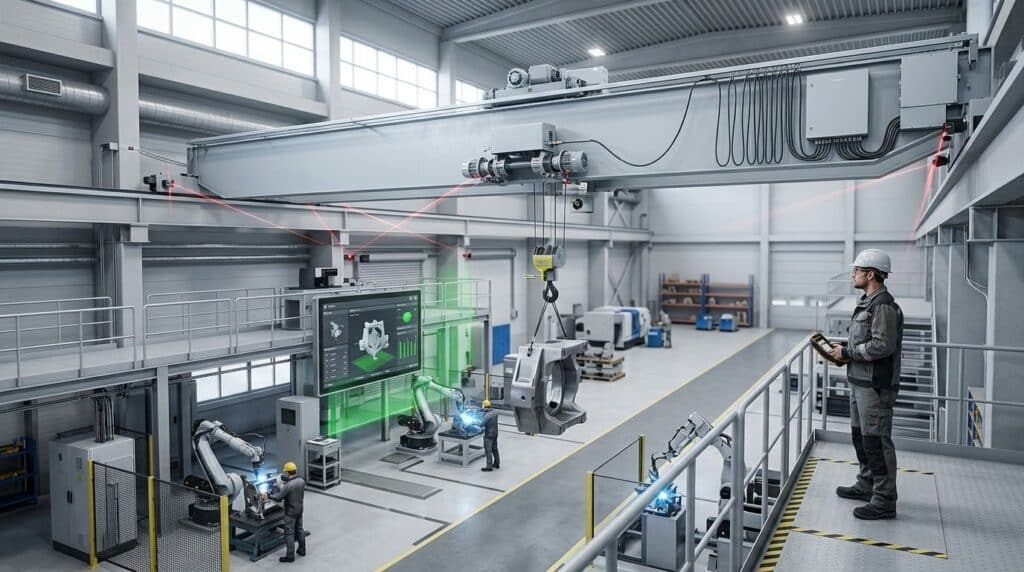
● Encoders on the drives track the precise position of the bridge and trolley, so the control system always knows where the crane is along the runway and across the bay.
● Laser and radar positioning measure distances to fixed references, walls, or other cranes, giving absolute position and proximity data.
● Load sensors report the weight on the hook, enabling overload protection and off-center pick detection.
● Area and limit sensors define the boundaries of where the crane is allowed to operate.
Feed those inputs into a PLC and the crane gains something it never had under pure pendant control: a live model of its own position, its load, and its surroundings. When paired with encoder feedback, the drives can position crane components to millimeter accuracy, which is what makes automated assembly and precise placement possible.
Semi-Autonomous Features: The Crane Starts Doing the Work
Once a crane can sense its position and control its motion precisely, a set of semi-autonomous capabilities becomes available. These keep the operator in charge of intent while the crane handles execution:
● Automated target positioning. The operator specifies a destination and the crane drives itself there, coordinating bridge and trolley travel and arriving with the load settled and placed, rather than being jogged into position by hand.
● No-fly zones. Software-defined areas where the crane is programmed to slow or stop, using motion control to keep loads out of protected space such as offices, walkways, or sensitive equipment. These zones can be reconfigured without moving a single physical barrier.
● Collision avoidance. Laser-based systems with a slowdown set-point and a stop set-point keep a crane from striking walls, equipment, or another crane sharing the runway. More advanced versions self-monitor and adjust automatically.
● Programmed repetitive moves. For repeated cycles, the crane can execute a stored sequence, which improves consistency and frees the operator from the monotony that invites error.
Each of these takes a task that used to depend entirely on operator skill and attention and turns it into a controlled, repeatable function. The technology upgrade that makes them possible is often applied to standard overhead bridge cranes, so a conventional machine can gain smart behavior through its control and drive systems rather than requiring an entirely different crane.
Full Automation and Where It Belongs
At the far end of the spectrum are fully automated cranes that run with no operator in the loop. Given a task by warehouse or plant software, the crane positions itself, lifts, transports, and places the load autonomously, using the anti-sway, positioning, and safety layers together in position-control mode. These systems are established in high-throughput, highly repetitive environments: automated warehouses, shipping ports, and steel coil and paper roll storage, where cranes cycle continuously on predictable moves.
Automation earns its place where the moves are repetitive, the environment is controlled, and throughput is relentless, because software outperforms a human at consistency and never tires. It is a weaker fit where lifts are varied, judgment-heavy, or performed in unpredictable, human-dense spaces, where an operator’s adaptability still wins. The interesting near-term reality for most facilities is not a binary between manual and lights-out, but a spectrum of assistance, adding anti-sway here, no-fly zones there, automated positioning on the repetitive lifts, while a person stays in the loop for everything else.
The Data Dimension
A crane that senses its position, its load, and its surroundings is also generating a stream of data, and a smart crane is usually a networked one. The same sensing and control that drive the motion can report position, load, and usage back to warehouse management and plant systems, letting the crane participate in the coordinated, data-driven flow of a modern facility. The motion intelligence and the data intelligence reinforce each other: the sensors that let a crane drive itself are the same ones that let it tell the rest of the operation what it is doing.
The Quiet Arrival of the Smart Crane
The transformation of the overhead crane is easy to miss because the machine still looks the same from the floor. The change lives in the control cabinet and the software, in VFDs running sway-control algorithms, PLCs fusing sensor data, and lasers watching for obstacles. Step back, though, and the trajectory is clear. The crane is moving along the same path as the rest of industrial automation, from a machine a human drives directly, to a machine that assists the human, to a machine that in the right setting runs itself. For a piece of equipment most people still think of as simple mechanical muscle, that is a quietly remarkable bit of engineering, and it is already well underway.