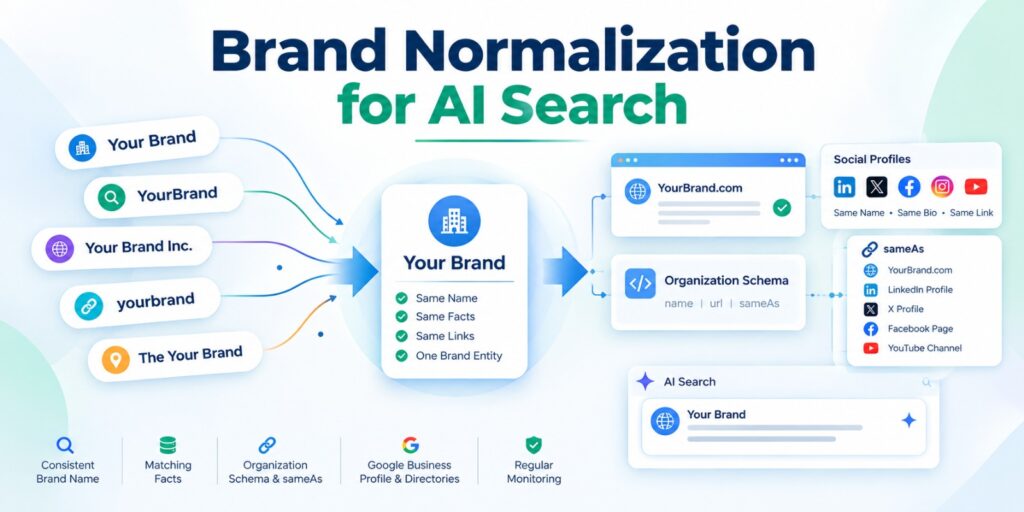
AI tools now answer brand questions in a single reply. They pull names, facts and links from many places. Brand normalization for AI search makes sure those places describe one brand. A brand name written five ways can look like five brands to a machine. Small gaps in spelling, spacing or address can split your identity. This guide shows how to fix that with simple, practical steps.
Brand normalization for AI search means using one exact brand name everywhere online. It also means keeping your facts and profile details identical on every platform. Matching details help AI systems link every mention to a single entity, which reduces confusion.
Key Takeaways
- One brand name and one set of facts should appear on every platform.
- Google says its AI features rely on its core Search ranking systems.
- Organization schema with sameAs links helps Google tell your organization apart from others.
- A Google Business Profile name must match your real-world name.
- A fixed review schedule catches new mismatches early.
Quick Answer
Pick one exact brand name and match your website, profiles and listings to it. Add Organization schema with name, url and sameAs links. Review everything on a set schedule.
What Is Brand Normalization for AI Search?
Brand normalization means standardizing how your brand appears in text, data and profiles. According to Wikipedia, entity linking is also called named-entity normalization. It assigns a unique identity to entities such as companies mentioned in text.
Think of it as brand consistency written for machines. People forgive a missing space or an old logo. Software reads names and facts as data, so small differences can matter more.
Brand guidelines cover logos, colors and tone of voice. Normalization covers the plain facts a system can read. Those facts include your legal name, short name, web address and profile links.
Is Brand Normalization an Official Google Term?
No, the phrase is common in SEO articles. Google documentation on this topic uses the word disambiguate instead. The goal is the same, which is to remove conflicting signals about your brand.
How Do AI Search Engines Interpret Brand Names and Entities?
Brand normalization for AI search starts with the idea of an entity. Many search systems treat a brand name as a distinct entity with its own facts. According to Wikipedia, entity linking is a key input for semantic search.
The Three Steps of Entity Linking
Wikipedia lists three subtasks in entity linking. Named-entity recognition finds names in text. Candidate generation picks possible matches, and disambiguation chooses the correct one.
In practice, a shared name can produce several candidates. Clear and matching facts give the disambiguation step more to work with. Conflicting facts do the opposite.
Why Small Brands Feel Mismatches First
If few pages mention your brand, each wrong detail carries more weight. One old address can outvote a single correct page. Clean records protect a small brand more than a large one.
How Google AI Features Find Brand Information
Google says its generative AI features are rooted in its core Search ranking systems. They use retrieval, which pulls relevant pages from the Search index. They also use query fan-out, which runs several related searches at once.
One question can trigger several searches about your brand. Every page that mentions your brand should state the same facts. Conflicting pages send mixed signals.
What Google Says About AEO, GEO and Structured Data
Google says AEO and GEO are still SEO from its point of view. It also says structured data is not required for generative AI search. No special schema markup is needed.
Google still suggests keeping structured data as part of your wider SEO work. No public source shows how every AI tool resolves brand names. Treat normalization as a clarity task and not a ranking trick.
How to Keep Your Brand Name Consistent Across Your Website and Social Profiles
Choose one exact brand name, then copy it everywhere without changes. Decide the spelling, spacing, capital letters and short form once. Write these choices in a fact sheet that your team can reuse.
Where to Match Your Brand Name
Start with the places you control. Google advises matching your Organization markup to your site name. The table below shows what to match in each place.
| Place | What to match |
|---|---|
| Website header and footer | Exact brand name and logo |
| Title tags | Same spelling and word order |
| About page | Full name, short name and founding details |
| Contact page | Address, phone number and email |
| Social profiles | Display name, handle, bio and website link |
| Author and press pages | Brand name in bylines and boilerplate text |
Fix the About Page First
The About page is the natural place to state who you are. Use your full brand name in the first sentence. Add your short name, location, contact details and a plain description of what you do.
Google suggests placing Organization markup on the home page or a page about your organization. An About page often fits that role well. Keep its facts identical to your schema.
Match Social Profile Names and Bios
Use the same display name on every social profile. Keep the handle the same where the platform allows it. Link each profile back to your website and use your logo as the picture.
Copy your short bio from the fact sheet and not from memory. Old bios often keep outdated names or addresses. Close old profiles you no longer use.
Keep Your Domain Clear
Pick one main domain for your brand. Redirect other versions, such as www and non-www, to it. Google advises reducing duplicate content on your site.
How to Keep Google Business Profile and Directory Details Consistent
This part of brand normalization for AI search applies to brands with local customers. Online-only brands can skip address fields and focus on their website and profiles. Local brands should read the next parts closely.
Follow the Google Business Profile Name Rule
According to Google Business Profile guidelines, your name should match your real-world name. It should appear the same on your storefront, website and stationery. It should also match what customers already call you.
Google does not allow unnecessary information in a business name. Breaking this rule could lead to a suspended profile. Special characters or legal terms need real-world proof, such as signage or invoices.
Keep Directory Listings in Line
Use the same name, address and phone number in every directory. Small changes such as Street and St can look like two records. Pick one format and copy it.
Google says Business Profiles can help your business appear in AI responses. They can also help in other Search results. Claim your listings and fix wrong details.
How to Use Organization Schema and sameAs for Brand Normalization for AI Search
Organization schema is structured data that states your brand facts in a format machines read. According to Google Search Central, it can help Google understand your organization. No properties are required, so add the ones that apply.
Properties That Support Brand Normalization
Google recommends focusing on name and alternateName for your business name. The name should match your site name. Use legalName only when the registered name differs.
Add url so Google can uniquely identify your organization. Add a logo that is at least 112 by 112 pixels. The logo file must be crawlable and indexable.
Use the most specific Organization subtype that fits your business. A local shop should use a LocalBusiness subtype. Place the markup on your home page or an About page.
How to Use the sameAs Property Correctly
Google describes sameAs as a link to a page on another site about your organization. Examples include a social media profile or a review site profile. You can list several links.
Schema.org says the linked page should unambiguously show the identity of the item. Its examples include a Wikipedia page, a Wikidata entry or an official website. Only link pages that truly represent your brand.
Add a Wikipedia or Wikidata link only if a page about your brand really exists. Check that every link opens the right profile. Test your markup with the Rich Results Test before publishing.
Used together, these fields make brand normalization for AI search easier to apply. Each value should match your fact sheet and your visible page text. Update the markup whenever the fact sheet changes.
Common Mistakes That Confuse Brand Identity
These mistakes weaken brand normalization for AI search and are easy to fix. Most come from a change made in one place and missed in another. Each one below can make one brand look like several.
Mixing Name Spellings and Formats
Spacing, capital letters and punctuation can differ from one profile to the next. One word in one place and two in another can look like a different brand. Choose one form and keep it.
Changing the Name Without Updating Old Profiles
A rebrand often leaves old names in directories, bios and press pages. Those old pages keep describing your brand under the former name. List every profile before you announce a change.
Stuffing Keywords Into Business Names
Adding extra keywords to a Business Profile name breaks Google guidelines. Google says unnecessary information in the name can lead to suspension. Use only your real-world name.
Letting Schema and Page Text Disagree
Markup that names a different brand from the page text sends mixed signals. The same goes for old phone numbers or addresses in the markup. Keep both in sync with your fact sheet.
Linking Weak or Wrong Pages in sameAs
A sameAs link to a page that does not clearly represent your brand adds noise. Skip random mentions, forum threads and unrelated pages. Link only profiles you own or official reference pages.
How to Monitor and Update Brand Information
Brand normalization for AI search is not a one-time task. Names, addresses and profiles change over time. A short routine keeps your records matched.
A Simple Monitoring Routine
- Write a fact sheet with your exact name, address, phone and links.
- Search your brand name on Google and note any wrong details.
- Ask an AI search tool about your brand and check the answer.
- Check every profile and directory against the fact sheet each quarter.
- Test your Organization markup with the Rich Results Test after every change.
- Review the Generative AI performance report in Search Console.
- Update every profile, listing and schema field on the same day after a change.
Google warns that no third-party tool has access to its internal ranking or AI systems. Use such tools if they help your workflow, but check their advice against official guidance. Your own fact sheet remains the best reference.
What to Do When Your Brand Name Changes
List every place the old name appears. Update the website, schema, profiles and listings in one batch. Keep redirects from old URLs in place.
Assign One Owner
Name one person who owns the fact sheet. That person approves every change to the brand name or address. Everyone else sends requests to that owner. Keep the fact sheet in a shared folder so everyone sees one version. Review new content for brand name accuracy before you publish it. More practical SEO and tech guides are available on TechWorldGarage.
FAQs About Brand Normalization for AI Search
What is brand normalization in SEO?
Brand normalization in SEO means using one exact brand name and one set of facts. It reduces conflicts between your website, profiles, listings and schema. Google documentation describes a similar goal as disambiguating your organization.
Does Organization schema help with AI search?
Google says structured data is not required for generative AI search. It still recommends structured data as part of overall SEO. Organization markup can help Google tell your organization apart from others.
What should I put in the sameAs property?
Add links to pages that clearly represent your brand, such as official social profiles. Schema.org also lists Wikipedia and Wikidata pages as examples. Skip pages that only mention your brand.
How often should I check my brand information in 2026?
A check every three months is a practical schedule in 2026. Review again after any rebrand, move or phone change. Regular checks catch errors early.
Can brand normalization guarantee that AI tools mention my brand?
No. Google says indexing and serving are never guaranteed, even when a page follows every guideline. Normalization removes confusion but cannot promise placement.
Is Brand Normalization for AI Search Worth the Effort?
Yes, because the work is small and the gain is clarity. One name, one fact sheet and matching profiles reduce guesswork for people and software. Wikipedia describes entity linking as the task of giving each mentioned company a unique identity.
Google Search Central publishes an official Organization structured data guide. It lists name, alternateName, url, logo and sameAs among its recommended properties. Start there, then compare every profile with your fact sheet.
Brand normalization for AI search is steady maintenance more than a one-time project. Fix the biggest mismatches first, then keep your records current. For the exact meaning of the sameAs property, read the official Schema.org definition.