Deploying a temporary water treatment plant is as much a controls challenge as a process one. The tanks, pumps, and clarifiers do the treating, but the control system decides how fast the plant comes online and how cleanly it fits into an operation that’s already running. Get the automation right, and a mobile unit can start treating within days without pulling operators away from the main plant. This article looks at the technology that makes that possible.
The Control System Is the Startup Path
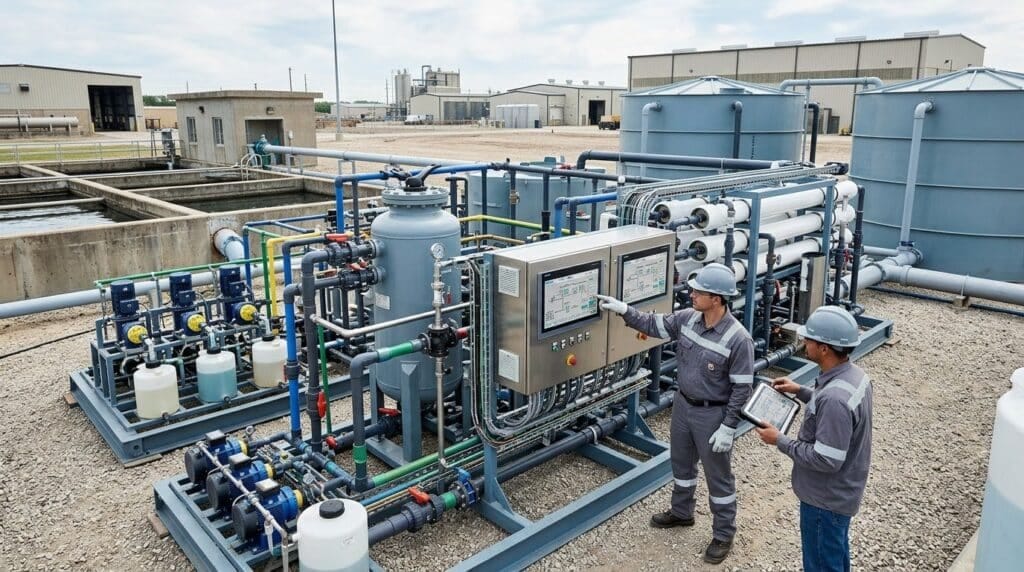
When a mobile treatment train reaches a site, its control system turns a set of connected skids into a working plant. Mobile units ship with a unified control system that manages pumps, valves, chemical feed, and instrumentation as one coordinated process. Because the control logic is engineered and configured in advance, commissioning on site becomes a matter of connecting, checking, and starting, with the sequence already in place.
Standalone or Integrated With Your Plant
A mobile system needs to fit whatever controls already exist on site. A unified control system can run on its own for a fully independent temporary plant, or it can exchange signals with the site’s programmable logic controller (PLC) and supervisory control and data acquisition (SCADA) system. That integration covers the essentials operators rely on:
● Start and stop commands from the existing control room
● Alarms that surface upsets and equipment faults in real time
● Flow pacing that keeps the mobile unit in step with plant hydraulics
Running in parallel this way lets the temporary system carry its load without competing for operator attention.
Automation Holds Treatment on Target
Temporary duty often means variable water, and automation is what keeps effluent steady through the swings. Instrumentation reads flow, level, and water quality, and the control system adjusts chemical feed to match. Coagulant and polymer dosing tracks the incoming load, so the process holds its target as conditions change. Automated feed also uses chemicals efficiently, which matters when every drum on site has to be delivered and stored.
Clean Signal Integration Protects Uptime
The value of good controls shows most during the handoff between systems. Clear points of connection, defined signals, and documented logic let a mobile unit tie in without disrupting the plant around it. Standard connections and clear process diagrams speed the physical hookup, while agreed alarm and data mapping keeps the control room informed. The result is a temporary plant that behaves like part of the permanent one.
The Control Strategy Follows the Process
Good automation starts with the treatment goal. The control logic is designed around the process the water needs, so the sequence, the setpoints, and the alarms reflect how that specific train is meant to run. WesTech takes this process-driven approach across its mobile systems and operations, building the controls to match each treatment goal so the automation fits the job.
Bringing It Online
For a mobile plant, the control system is the difference between equipment on a pad and a plant doing work. Pre-built logic shortens commissioning, PLC and SCADA integration keeps operators in command, and automated feed holds quality steady as the water shifts. Plan the controls alongside the process, and a temporary system can be online in days and dependable for as long as the site needs it.