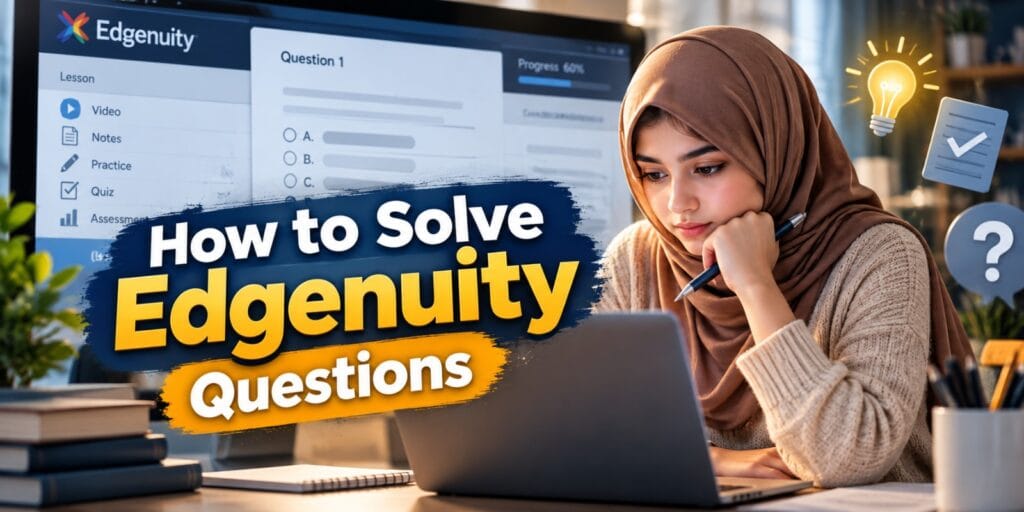
There’s a specific kind of frustration that comes from understanding a lesson just fine and then staring at the quiz question that follows it like it’s written in a different language. You watched the video. You even took notes. Then the question shows up worded in a way that doesn’t match anything you remember seeing, and suddenly you’re second-guessing everything.
That’s usually the moment someone opens a new tab and types Solve Edgenuity Answers Instantly. It’s a normal thing to search for. Nobody wants to burn twenty minutes on a single quiz question when they’ve got four other classes waiting. But here’s the thing worth saying upfront: this article isn’t going to hand you a shortcut that skips understanding altogether, because those shortcuts don’t really exist for the harder questions anyway. What it will do is walk you through how to actually figure out what a confusing question is asking, where to look for the answer inside the lesson you already watched, how to rule out the choices that are designed to trick you, and how to double-check yourself before you hit submit.
This works whether you’re stuck on a quiz, a lesson check, a full assignment, or one of the bigger assessments. The goal is the same either way — get through the coursework faster without just guessing and hoping.
What Makes Edgenuity Questions Difficult?
Before jumping into strategy, it helps to understand why these questions trip people up in the first place. It’s rare because the student didn’t pay attention.
The question tests the lesson, not just memory
A lot of Edgenuity content is built so the question rephrases the concept rather than asking it back word-for-word. You might know exactly what photosynthesis does but freeze when the question describes it using a scenario instead of the textbook definition. That’s not a knowledge gap — it’s a wording gap, and it’s fixable once you know to look for it.
Multiple-choice answers can look almost identical
This is probably the biggest source of wrong answers. Two choices will say almost the same thing, with one word changed, or one option will be technically true but not the best answer to what’s being asked. Edgenuity leans on this kind of distractor a lot, especially in science and reading sections.
Students skip the information they actually need
It’s tempting to read a question, feel unsure, and just start guessing between two options. But going back to the lesson text or rewatching thirty seconds of a video is almost always faster than guessing wrong twice.
The practical takeaway here: don’t rush to search for an answer online before you’ve even figured out what subject skill or key term the question is built around. That step alone saves a lot of wasted time.
How to Solve Edgenuity Questions Step by Step
This is the part that actually matters, so let’s slow down and go through it properly.
1. Read the question twice
The first read is just to get oriented — what topic is this, roughly what’s being asked. The second read is where you actually pin down the specific thing the question wants. A lot of mistakes happen because students answer the first read instead of the second one.
2. Find the key words
Certain words change everything about how you should approach a question. Words like cause, effect, compare, explain, evidence, main idea, purpose, most likely, and best describes each point toward a different kind of answer. If a question says “which best explains,” you’re not looking for a true statement — you’re looking for the most complete or most directly supported one.
3. Return to the relevant lesson
This sounds obvious, but plenty of students skip it because rereading feels slower than guessing. It usually isn’t. Go back to the lesson text, the video, worked examples, definitions, any charts or diagrams, or notes you took while going through the material the first time. The answer is almost always sitting somewhere in there, just not phrased the same way the question phrases it.
4. Eliminate obviously incorrect choices
Before trying to pick the “right” answer, get rid of the wrong ones. An answer choice is usually wrong if it contradicts something the lesson said, answers a slightly different question than the one asked, is way too broad or too narrow, or uses terminology that doesn’t match what the course actually taught. Cutting two or three bad options down to two makes the real decision much easier.
5. Compare the final two choices
Once you’re down to two, stop asking “which one sounds right” and start asking “which one is more directly backed by what the lesson said.” This is usually where the correct answer separates itself — one option needs you to make an assumption, and the other doesn’t.
6. Check before submitting
Give it one more pass. Did you misread anything? Is there a “not” or “except” hiding in the question that flips the whole meaning? Are the units or numbers right if it’s a math problem? A ten-second check here catches a surprising number of careless mistakes.
Can You Solve Edgenuity Answers Instantly?
Honestly? Sometimes, yes — the easy stuff. A vocabulary question or a straightforward recall question can genuinely be solved in a few seconds once you know the lesson. That’s a fair use of the phrase Solve Edgenuity Answers Instantly, and there’s nothing wrong with wanting that for the parts of the coursework that don’t need deep thought.
But for harder questions, “instant” really means “fast once you understand it,” not “skip the understanding part.” The workflow looks something like this: read the question, figure out what topic it’s pulling from, go find the evidence in the lesson, cross off the wrong choices, double-check, then submit. That sounds like a lot written out, but once you’ve done it a few times it becomes second nature and takes way less time than it sounds like it should.
The point isn’t to avoid speed — it’s to avoid blind copying. Fast and accurate beats fast and wrong, especially since wrong answers usually cost you more time in the long run when you have to go back and fix them.
How to Use Edgenuity Lesson Material to Find the Right Answer
Most Edgenuity questions are built directly from specific parts of the lesson, which means the lesson itself is your best resource almost every time.
Definitions matter more than students give them credit for. Vocabulary and concept-based questions usually hinge on the exact definition given in the lesson, not a looser version you might remember from a previous class. If a question feels like it’s testing a term, go find how that term was actually defined in this course.
Examples are worth a second look too. Whenever a lesson walks through an example, it’s usually showing you how a concept gets applied — and that’s often exactly the format the quiz question will use.
Headings and section titles inside the lesson content can help you jump straight to the right spot instead of rereading the whole thing. And if you notice the same idea showing up in the explanation, then again in an example, then again in a summary, that’s usually a signal the concept is central enough that it’s likely to show up in the assessment.
Strategies for Different Types of Edgenuity Questions
Not every subject works the same way, so it helps to adjust your approach a little depending on what you’re dealing with.
Multiple-choice questions go smoother when you read the question first and form a rough idea of the answer before you even look closely at the options — that way the wording of the choices doesn’t accidentally steer you. From there, eliminate what’s clearly wrong and compare what’s left against the lesson.
Math questions benefit from writing down what you actually know before doing anything else. Figure out what calculation is being asked for, then double-check your signs, units, decimals, and formulas before locking in an answer. If the result looks strange — like a negative age or a percentage over 100 — that’s usually a sign something got mixed up along the way, and it’s worth recalculating.
Reading and English questions usually come down to separating what the passage actually says from what you’re assuming based on general knowledge. Nail down the main point first, then check whether each answer choice is backed by something stated in the text or whether it’s just plausible-sounding.
Science questions often test relationships between cause and effect, or ask you to tell the difference between an observation and a conclusion. Go back to the specific definition or relationship the lesson introduced rather than relying on outside science knowledge that might use slightly different terms.
History and social studies questions hinge a lot on specifics — dates, names, causes, effects, context. A common trap here is picking an answer because it’s generally true of the era, even though it doesn’t actually answer what the question is asking about that particular event.
What to Do When You Can’t Find an Edgenuity Answer
Sometimes none of this works right away, and that’s fine. Here’s a reasonable order to work through it: reread the question slowly, pin down any word or term you’re unsure about, go back to the exact lesson section that covers it, check your notes or any examples you saved, then try breaking the question into smaller pieces instead of tackling it all at once. From there, eliminate whatever clearly doesn’t fit, and if you’re still stuck, ask a teacher or tutor — that’s what they’re there for.
One thing worth being careful about: searching for the exact question online can turn up answers that are outdated, copied incorrectly, or just wrong, since Edgenuity questions and courses get updated over time. The lesson material you were actually given is a far more reliable reference than a random answer key floating around the internet.
Common Mistakes Students Make When Looking for Edgenuity Answers
A few patterns show up again and again. Searching for an answer before actually reading the question carefully is a big one — it leads to picking whatever result seems close enough rather than what’s actually correct. Copying an answer without understanding why it’s right causes problems later, especially on cumulative tests. Trusting an answer site blindly, without checking it against your own lesson, can backfire since course content varies. Missing small words like “except,” “not,” or “best” flips the meaning of a question completely. Spending too long stuck on one question eats into time you need elsewhere. And using the exact same strategy for every subject doesn’t work — math and history questions just aren’t solved the same way.
This is really where a search like “Solve Edgenuity Answers Instantly” earns its keep — it’s a fine starting point for finding help, but the actual value comes from learning to verify what you find rather than accepting it at face value.
A Faster Edgenuity Study Strategy That Actually Saves Time
Here’s a rough system that a lot of students find useful once they get the hang of it. Think of it as five stages rather than five literal minutes, since some questions take longer than others.
Start by reading the question and figuring out what type it is. Then go find the relevant information in the lesson. Next, eliminate the answers that clearly don’t hold up. Pick the one that’s actually backed by evidence from the course, not just the one that feels familiar. And finally, glance back over your choice before submitting.
The timing will stretch or shrink depending on the subject and how tricky the question is — the real purpose of breaking it into stages is just to stop yourself from spiraling into aimless guessing when a question feels hard.
How to Check an Edgenuity Answer Before Submitting
Before you lock in an answer, it’s worth running through a quick mental checklist. Did you actually answer the exact question that was asked, or a slightly different version of it? Is your answer backed by something specific from the lesson, or is it more of a guess? Did you check for words like “not,” “except,” or “best” that change the meaning? If it’s a calculation, does the result actually make sense? And maybe the most useful test of all — could you explain out loud why this answer is correct? If you can’t, it might be worth reconsidering.
This kind of self-check matters more than people think. It’s the difference between understanding the material and just happening to land on the right letter.
Final Thoughts: Solve the Question, Not Just the Answer
The fastest long-term way through Edgenuity coursework isn’t finding a trick that skips the thinking — it’s getting good at recognizing how the questions are built. Once you can spot what a question is really asking, go straight to the right part of the lesson, eliminate what doesn’t fit, and double-check your answer before submitting, the whole process gets noticeably quicker. That’s really what people are after when they search for something like solve Edgenuity answers instantly — not a way around the work, but a way through it that doesn’t waste time.
If a question has you stuck, don’t immediately guess. Read the wording carefully, go back to the lesson it’s pulling from, cross off what clearly doesn’t belong, and check your answer before you submit it. That simple process can turn a frustrating question into a solvable one — and it’ll get you through your coursework with a lot more confidence than guessing ever will.
FAQs About Edgenuity Questions and Answers
How can I solve Edgenuity questions faster?
Get comfortable identifying what type of question you’re looking at, go straight to the relevant lesson section instead of guessing, cut out the wrong answers first, and verify before submitting. Speed comes from skipping the guesswork, not from skipping the thinking.
Where can I find help with difficult Edgenuity questions?
Start with the lesson itself — the video, the text, and any examples given. After that, your own notes, a teacher, a tutor, or a trustworthy study resource are all reasonable next steps.
Is there a way to solve Edgenuity answers instantly?
For simpler, more direct questions, yes — those can be answered quickly once you know the material. Harder questions still need you to understand the underlying concept, and verifying an answer is a lot more reliable than copying one without checking it.
Why do I get an Edgenuity question wrong even when I understand the lesson?
Usually it comes down to how the question is worded, a distractor answer that looks close to correct, a small detail you missed, or applying a concept slightly differently than the question intended.
How do I check whether an Edgenuity answer is correct?
Compare it directly against the lesson’s explanation, examples, definitions, or any calculations and evidence given in the course material.
What should I do if I still don’t understand an Edgenuity question?
Break it down into smaller parts, go back to the lesson section it’s pulling from, figure out exactly which concept is missing for you, and don’t hesitate to ask a teacher or tutor to fill that gap.