
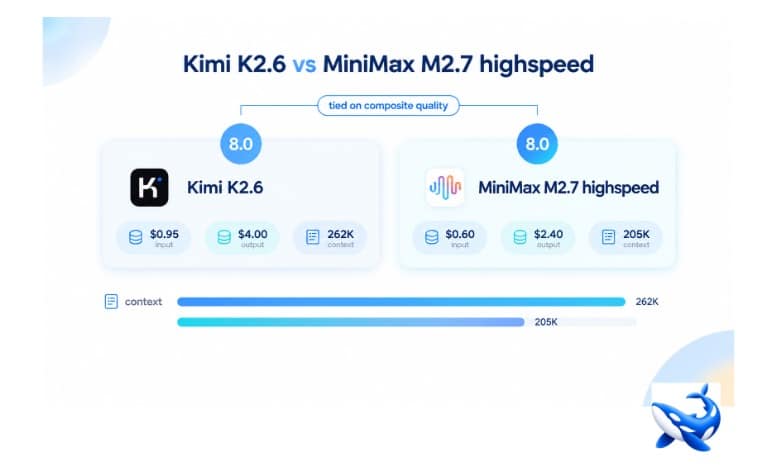
Two endpoints, one composite score, and a price table that says they belong in the same bracket. On OrcaRouter the Kimi K2.6 vs MiniMax M2.7 highspeed comparison is the tightest pair we publish: both land at 8.0 on our quality scale, both are cheap enough to run at volume without a budget conversation, and the headline prices are close enough that a buyer could reasonably flip a coin. The interesting part is that the two things which actually separate them are not on the headline at all.
Both cards scored 8.0. Here is the rest of the table.
Read on 2026-10-13:
| metric | Kimi K2.6 | MiniMax M2.7 highspeed | gap |
| input, per million tokens | $0.95 | $0.60 | MiniMax is 37% cheaper |
| output, per million tokens | $4.00 | $2.40 | MiniMax is 40% cheaper |
| output-to-input multiple | 4.2x | 4.0x | near-identical billing shape |
| context window | 262K | 205K | Kimi carries 57K more |
| composite quality, 0–10 | 8.0 | 8.0 | tie |
Three things stand out once the table is laid out. First, MiniMax wins both price lines by a wide margin — 37% on input and 40% on output — so this is not the crossing pattern where the cheaper card depends on your mix. Second, the billing shapes are nearly the same, so that price advantage holds whatever your read-to-write ratio looks like. Third, the only column where Kimi leads is the context window, and the lead is modest: 57K tokens.
The score tie means the decision is not about capability
Our composite quality column is ours: a 0–10 figure we compute from four families of evaluation we run against each endpoint — reasoning, code generation, long-context retrieval and instruction following — averaged into one number. It is not a third-party leaderboard, and it is not reproducible on someone else’s harness.
An 8.0 on both sides is the bottom of the twelve-model set we price, and a tie at the bottom should be read carefully. A composite averages away the shape of a model’s failures, and two models that both average 8.0 can break on completely different inputs. For a narrow workload — one task, one output schema, one failure mode you actually care about — an aggregate that flattens four evaluation families tells you less than an afternoon of running your own traces. What the tie does settle is the thing it is often asked to settle: on our measurements, neither card buys you capability over the other.
What 57K tokens is worth
That leaves the context window, and the honest reading is that 57K is a real but narrow advantage. Kimi K2.6 holds 262K tokens; MiniMax M2.7 highspeed holds 205K. Both are far below the 1M that eight of the twelve models in our table carry, which is the more important fact about this pair — if your documents are long, neither of these cards is the answer, and the decision on this page is between two models that will both force you into chunking.
If your inputs sit comfortably inside 205K, the window difference costs you nothing and the 37–40% price advantage decides the pair outright. The gap only starts to matter in the band between 205K and 262K — a range that is narrow, and a range you can measure rather than guess at. Count your actual token distribution. If nothing lands in that band, Kimi’s window is not a feature you are paying for.
Where the money actually goes on a pair this cheap
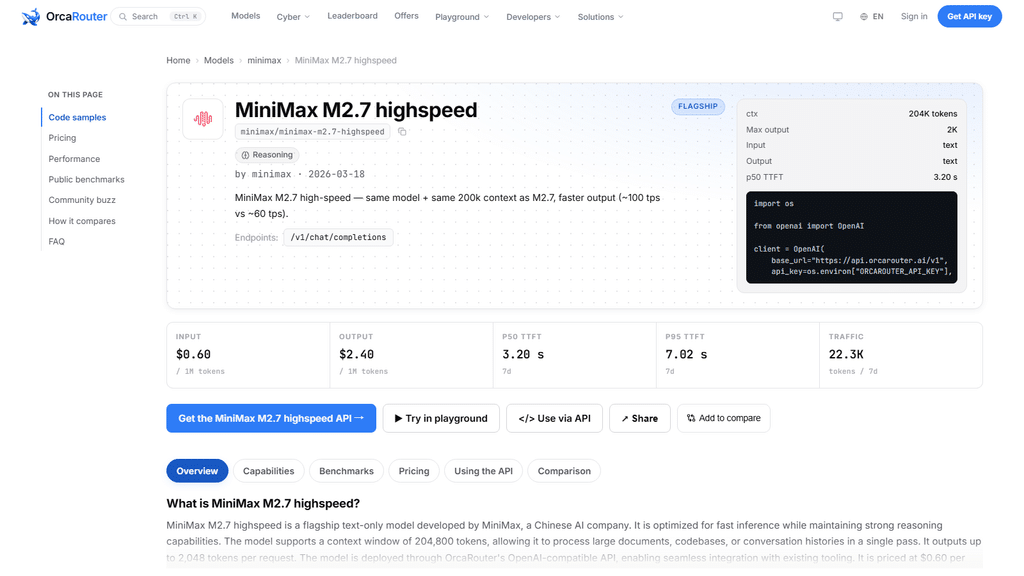
At $0.95 and $0.60 per million input tokens, neither card is going to produce a surprising invoice, and that changes what you should optimise for. On an expensive pair the price gap dominates everything; here, the difference between the two cards on a million-token read is thirty-five cents. What dominates the bill instead is the shape of the workload — how many times your pipeline reads the same text, and how much the model writes back.
That is why the context window deserves more weight here than its 57K headline suggests. A window that is too small does not fail loudly; it forces chunking, and chunking means re-reading overlapping spans. Read the same document twice to work around a window that will not hold it, and you have just paid the input rate twice — which for Kimi at $0.95 is $1.90 per million, against a single $0.60 pass on MiniMax. The cheaper card stops being cheaper the moment your architecture has to grow around a window it cannot hold.
Two cards, one integration
Both endpoints are served at list price behind the same base URL, the same authentication and the same response shape on OrcaRouter, so the experiment here is a string change rather than a second contract. That matters more on a tight pair than on a lopsided one: when the price difference is 37% and the quality score is identical, there is no argument left to have in the abstract. Either your inputs fit in 205K or they do not, and that is a fact about your traffic, not about the models.
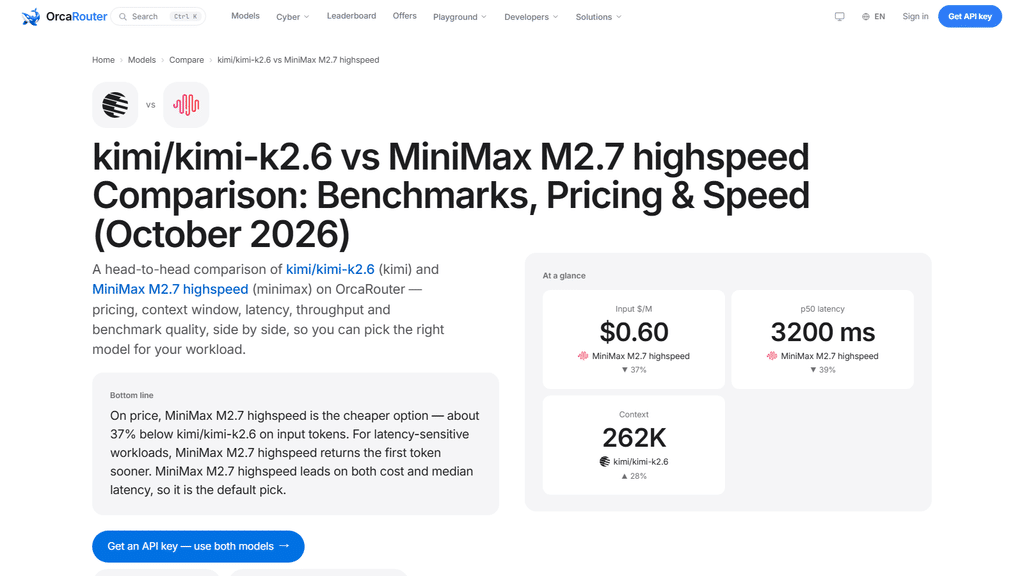
Split a slice of your batch, run it through both, and count the tokens rather than estimating them. On a pair where the price gap is this small, the answer is more likely to come from your token distribution than from the table.
The pair, priced at a matched million
A single balanced pair makes the size of this decision plain. Read a million tokens and write a million through each card. Kimi K2.6 bills $4.95. MiniMax M2.7 highspeed bills $3.00. The entire argument between the two cards is $1.95 per matched pair.
That figure is worth holding next to the 57K window difference, because it reframes which question is actually being answered. On most comparison pages the cheaper card saves real money and the more expensive one buys real capability, and the article is about that trade. Here there is no capability trade — both score 8.0 — and the money is small enough that a single re-read erases it. Read one document twice on MiniMax to work around a window it cannot hold and you have paid $1.20 per million instead of $0.60, which is already more than Kimi’s single $0.95 pass. On this pair the window does not merely outweigh the price advantage; it outweighs it on the first retry.
The takeaway
Kimi K2.6 and MiniMax M2.7 highspeed both score 8.0 on our composite scale, so neither card buys capability over the other on our measurements. MiniMax is cheaper on both lines — 37% on input, 40% on output — and the difference is not mix-dependent, because the two billing shapes are nearly identical. Kimi’s only edge is 57K more context, which is worth paying for only if your inputs actually land in the 205K-to-262K band. For bounded work, MiniMax is the default; for work that brushes against 205K, Kimi is the card, and 57K is a thin reason to pay 40% more on output.
Both are live at list price behind a single key, so the honest test is to look at your own token counts before you look at either rate card again.
Sourcing note: prices, context windows and output-to-input multiples were read off our own comparison page for this pair on 2026-10-13. The composite quality column is OrcaRouter’s own 0–10 scale, computed from four evaluation families we run against each endpoint, and is not a third-party index. The comparison page and the model page linked above are OrcaRouter production pages. All checked 2026-10-13.